Leveraging AI and Big Data to Enhance Safety Analysis

Leveraging AI and Big Data to Enhance Safety Analysis

Machine-learning applications across connected vehicles, street-view imagery, LiDAR, speed prediction, road-user behavior, and surrogate safety measures.

NCHRP 17-100 · Research Report 1152 · Research project

Project story

From question to working system.

This multi-part research effort investigated how artificial intelligence, machine learning, and emerging transportation datasets can strengthen conventional highway-safety analysis and help agencies move beyond an exclusive reliance on historical crashes.

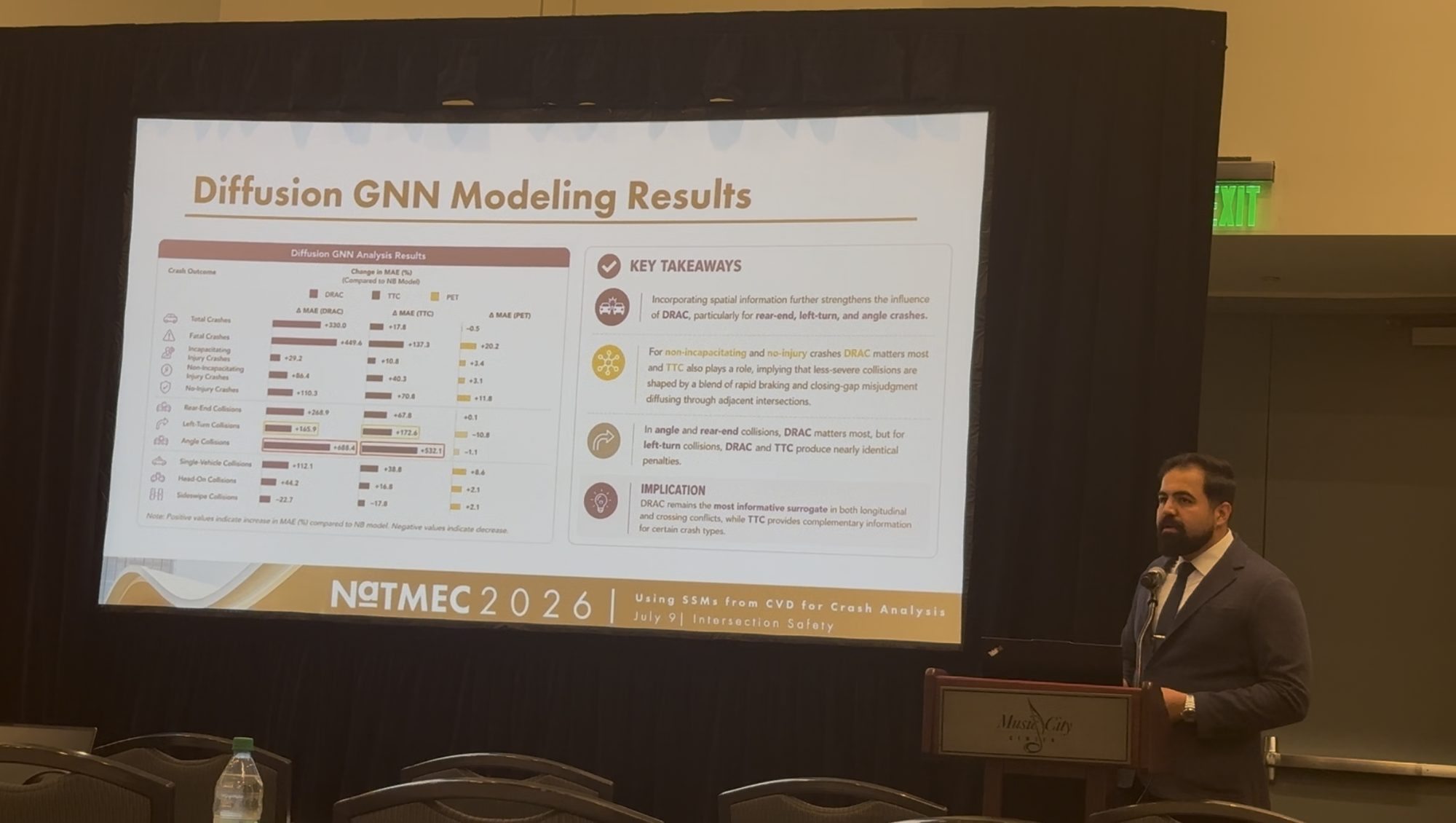
The guide organizes six applied research studies spanning connected-vehicle turning movements, street-level imagery, LiDAR roadway inventories, proactive conflicts, road-user behavior, and other safety applications. The work links data-source characteristics and validation choices to questions practitioners actually face.

My contributions included model development, coding, validation, technical documentation, user guidance, reporting, and engagement with federal and state stakeholders—connecting methodological experimentation with implementation needs.

6 studies

Applied investigations included in the practitioner guide

≥0.98

Precision in the ODOT roadway-luminaire pilot

≥0.90

Recall in the ODOT roadway-luminaire pilot

Multi-source

Connected vehicles, imagery, LiDAR, video, and agency data

My contributions

Roles and technical work.

  • Connected-vehicle and trajectory analysis
  • Street-view imagery and computer vision
  • LiDAR and infrastructure sensing
  • Speed and behavior modeling
  • Documentation, user guidance, and stakeholder exchange

Project gallery

Systems, fieldwork, and results.

Resources

Presentations, publications, reports, and links.