Overview
Why this research matters.
Traditional safety analysis often begins after crashes have already occurred. My work investigates how emerging mobility data and surrogate indicators can reveal network risk earlier and at finer spatial and temporal scales—so agencies can act before patterns become tragedies.
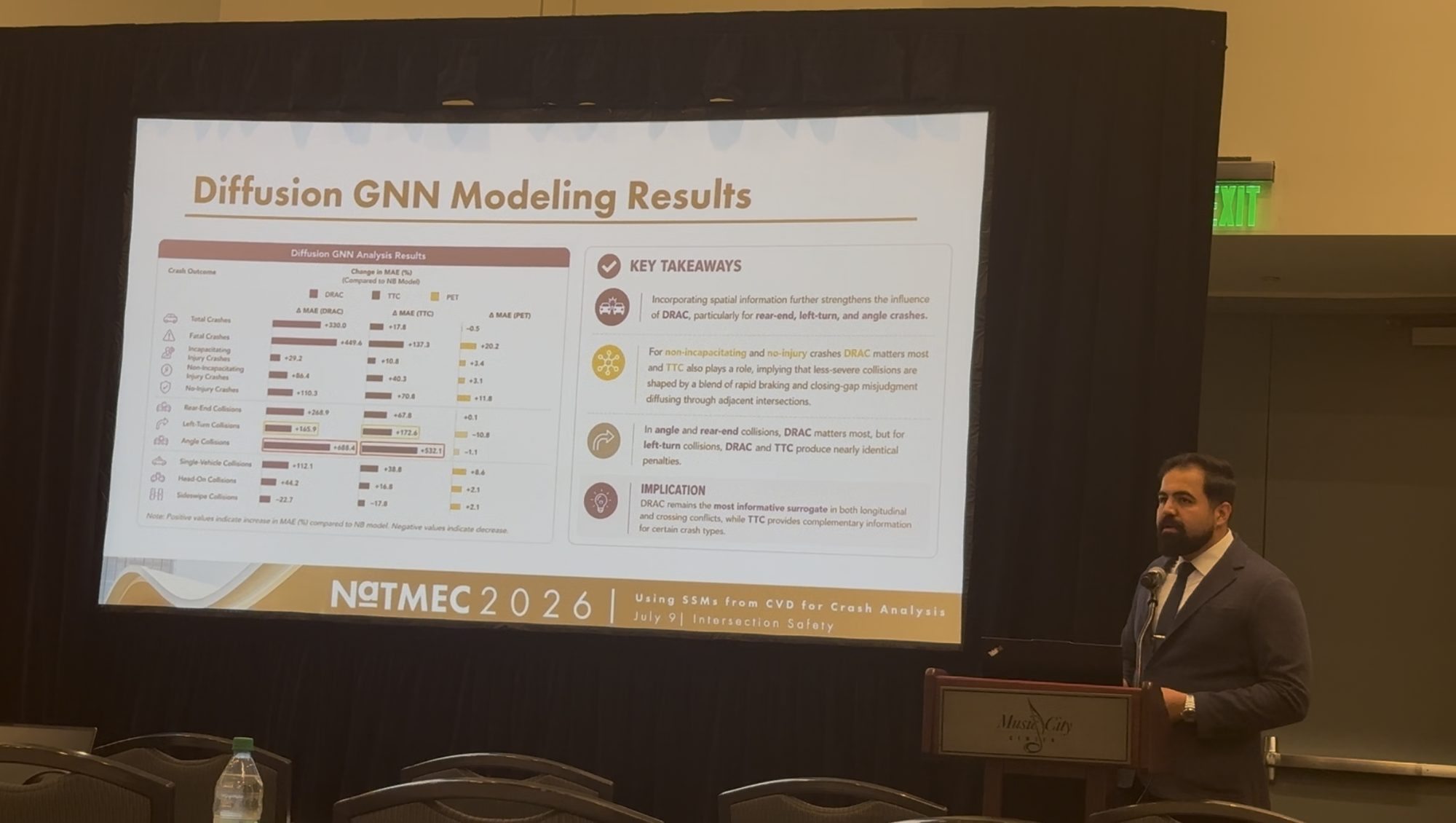
In a network-wide study of Tucson signalized intersections, I helped transform 54.8 million second-by-second connected-vehicle trajectory points into three surrogate safety measures and connect them with five years of police-reported crashes. Statistical, machine-learning, and graph-based models consistently identified critical deceleration rate to avoid a crash (DRAC) as the strongest of the tested indicators.
The results also show where surrogate measures should not be overextended. They were most informative for rear-end, left-turn, angle, and lower-severity crashes; sideswipe, single-vehicle, and severe outcomes require additional contextual and behavioral variables. That distinction is essential for responsible implementation.
